AI Agent for Autonomous Image Acquisition and Multimodal Analysis
Research & Application
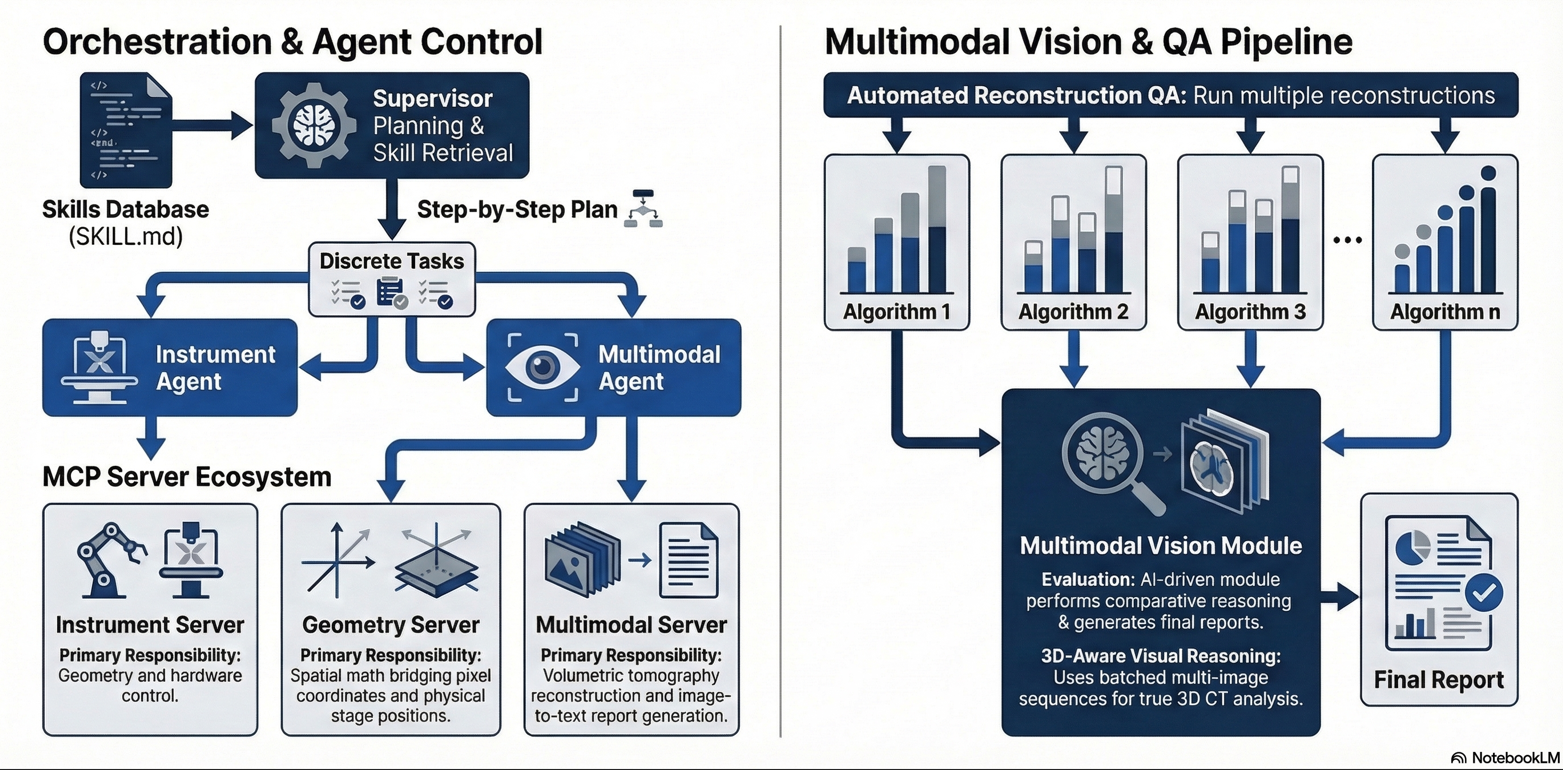
This project introduces a comprehensive AI orchestration framework designed to automate and enhance Carl Zeiss X-ray Microscopy (XRM) workflows. By combining Large Language Models (LLMs) with Model-Context Protocol (MCP) servers, the system allows scientists to control hardware, acquire images, and run complex analyses using plain-language commands.
The platform integrates two core systems into a unified LangGraph multi-agent state machine.
The Supervisor-Agent Architecture
The core orchestration relies on a hierarchical structure where a central Supervisor manages the workflow. The Supervisor queries the Skills, generates a step-by-step plan, breaks this plan into tasks, and assigns these tasks downward to the specialized agents.
- Instrument Agent: Operates in a continuous ReAct loop to control physical hardware via the proprietary XradiaPy API, managing axis movement, X-ray states, and image acquisition.
- Image Agent: Handles critical spatial and computational tasks, including 2D/3D segmentation, pixel-to-micron conversions, and stage recentering mathematics.
- Multimodal Vision Agent (AutotestAgent): Runs parallel to the other agents as a third specialized agent to manage an automated quality assurance pipeline for 3D CT reconstructions.
Multimodal QA and Visual Analysis
The AutotestAgent drives multiple ZEISS reconstruction executables (FDK, NLM, DRIQ, DRIC) and evaluates them to ensure optimal image clarity. It accomplishes this through a rigorous four-phase pipeline:
- Slide Image Extraction: Exports generated report slides as high-resolution PNG images.
- Perceptual Image Quality Assessment (IQA): Computes blurriness, sharpness, and contrast metrics, replacing standard SSIM with Learned Perceptual Image Patch Similarity (LPIPS) to better correlate with human perception of reconstruction quality.
- Multi-Image Comparative Visual Chain-of-Thought: Batches all algorithm outputs and orthogonal views into a single Claude (claude-sonnet-4-6) call, enabling the AI to detect XRM-specific artifacts and rank the algorithms.
- Report Assembly: Generates a structured JSON file with full numeric metrics and an annotated PowerPoint appendix highlighting the recommended algorithm and specific artifacts.
System Capabilities
This ecosystem is supported by a suite of specialized MCP servers for spatial calculations. Ultimately, the integration creates an end-to-end autonomous environment where researchers can seamlessly transition from physical data acquisition to advanced, multi-algorithm reconstruction analysis.